MIPS Letters from CMS

By Ryan Kelly –

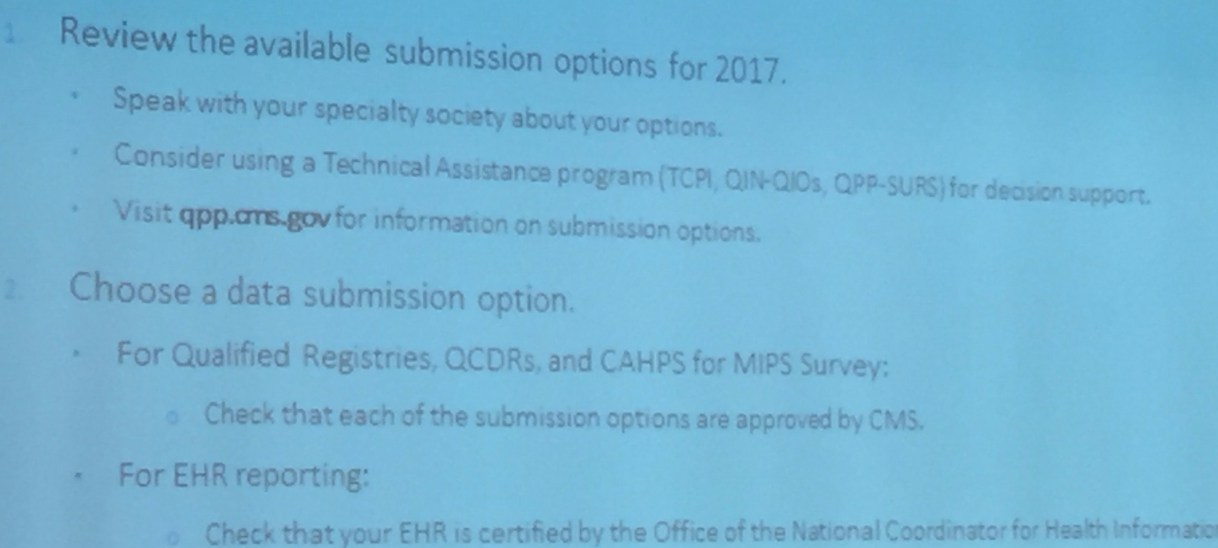
Mary Smith, nurse practitioner and administrator for the Starkville Orthopedic Clinic in Starkville, spoke at the Association’s Rural Health Clinic Conference in Jackson on April 7, 2017.  Mary delivered a presentation regarding the CMS process for submitting quality information for the Quality Payment Program (QPP) using MIPS.

Mary stated that CMS will be sending letters during the month of April to all individual providers who meet the MIPS threshold for reporting.  So, if you are a provider, be on the lookout for this letter.  If you are an administrator, make sure and notify your providers that this letter is coming.  For those designated “rural health,” your providers that submit Medicare Part B may still be eligible for MIPS even if your clinic is exempt for being in the legacy fee-for-service model.

Please contact us with any questions at 601.898.3001.

Rumors of a Bi-Partisan Healthcare Bill

By Ryan Kelly –

It hasn’t taken long for the rumors of a bi-partisan healthcare bill to take off.  If you have viewed my previous posts, this was my hope and somewhat my expectation.

A recent news article from Kaiser Health News detailed an honest interview from Rep. Don Young from Alaska admitting that the partisan failure was the parties’ fault:

“The reason why Obamacare failed was because it wasn’t a bipartisan bill,” said Don Young, Republican of Alaska. His party made the same mistake, he said, writing their bill without Democrats. “We were very frankly guilty of that.”

But, several legislators and White House officials are already hinting at the understanding of the need for a bi-partisan bill that thinks through the complexity of our healthcare system and addresses all needs in a manner that improves the current system and doesn’t cause many if any unforeseen problems.  While there was no direction of the path forward, the conversation has already begun…which is a good thing.

I was able to visit with elected officials in DC this week and had some good conversations with them regarding the AHCA.  When discussing the bill and its failure I repeated the same thing that we told them last month…take your time and get it right.

I am hopeful that Round 2 (whenever that occurs) will be slower, more methodical, and substantially better by having the Senate and House bring together both Republicans, Democrats, and constituent groups to provide a collective approach at solving our issues.

Where the ACA somewhat failed because of its highly partisan nature, a new healthcare bill could succeed by actually listening to others.

Of course, time will tell…

Voting on the AHCA

by Ryan Kelly –

Voting was set to take place today by the US House of Representatives on the new healthcare legislation.  But, due to the moderate and libertarian pulls of the GOP not coming to a consensus in time, the vote has been postponed to a later date.

Why is the vote delayed?

As I have been saying, we need to pump the breaks a bit on the specifics of the bill.  There are still details concerning to those that want to reduce the size and scope of government’s involvement in healthcare, as well as those…mainly from Medicaid-expansion states…that want to ensure the guarantees promised to their states for healthcare reform.  Of course, caught in the middle are the healthcare professionals searching for solutions to their many issues.

I expect many of these concerns will be satisfied in the coming days, and the vote in the House may take place next week (good for me, because I’ll be in DC and may be able to see the deliberation and vote in-person).

Even if House approves, not so fast

It is largely assumed that the House will eventually pass the bill and move it to the Senate. This is where the real fun starts, though.  The Senate can only pass this through budget reconciliation by 2 votes.  With the extremes of the party present in the Senate, there will be fierce negotiation and deal-making.

It’s in the Senate where the MRHA will align with other parties to ensure that rural is supported in the final markups.  All we need is to ensure that rural is considered with payment models, particularly the enhanced Medicaid requirement for the legacy fee-for-service clinics such as RHCs.

UPDATE

Since the time of the publish of this post, the House of Representatives withdrew the AHCA from the docket due to a lack of votes needed to pass.

My analysis of the above remains true.  I believe it’s a good thing that our legislators are going to take more time to build a more complete bill that addresses the many complexities and needs of our healthcare industry.  Although the first bill had many good components, it only addressed a fraction of the needs of healthcare professionals.  I anticipate that in the coming weeks or months, conversations with stakeholders like the MRHA / NRHA / NARHC will allow for a better bill which will pass the House easily.  And, possibly will already meet the needs of the Senate and will pass there too.

Time will tell.  For now, we’ll keep up the hard work to support rural health in all language both direct and indirect in the coming legislation.

New Amendments to Health Care Law

By Ryan Kelly –

GOP members released new amendments to the health care law designed to replace the Affordable Care Act.  Clearly expected and not-so-long awaited, these amendments are aimed to help win votes to allow the legislation to pass.  So, what’s in these amendments and what would it do to Mississippi?

If you read mass media, you will get a hint of fact mixed in a flurry of speculation.  One of my pet peeves here lately is a lack of informed content without opinion, so take anything you read from liberal or conservative sources with a big grain of salt.

New amendments include the following:

  • A possible requirement for those on Medicaid to work, participate in job training, or perform community service.
  • A revised option for states to receive Medicaid funds as a “block grant” versus a per capita system, which would allow states to receive a set block of funds per year versus a set amount per enrollee per year.
  • Prevention of any additional states to expand Medicaid coverage as prescribed in the ACA
  • Increased tax credits older enrollees

From here, the bill with amendments goes to the Rules Committee, where additional amendments and discussion is almost assured.  But, some experts think that the bill could receive all markups as early as Thursday of this week…meaning that the process will go much faster than many of us thought.

What does this mean for Mississippi?

It’s still unclear.  As I mentioned in my last analysis of this, it all depends on the specifics of Medicaid.  One very important change that the National Rural Health Association is pushing, and we as the MRHA are supporting, is an exception for rural facilities to continue to receive the enhanced Medicaid and Medicare funding as a federal requirement for Medicaid funding to states.  This amendment would be critical for Mississippi’s many rural facilities.

What is the MRHA doing?

First, we are petitioning lawmakers to consider the NRHA amendment.  Continuing enhanced payments for rural is a blip on the fiscal radar, but it is significant for our providers.

Second, we are preparing a marketing campaign directed specifically at Mississippi lawmakers and policymakers to show the benefit of enhanced rural payments.  When a lawmaker understands how a little extra up-front saves significant dollars in the entire system, it becomes an easy sell on why enhanced rural payments are important.  Without them, our ERs in metro areas become much busier, and the cost to the state increases significantly.  No one wants this…so it’s a message that we will continue to tell.

What can you do?

Right now their may not be enough specific information to make specific asks, but contacting your lawmaker and asking them to consider rural health with this legislation is a huge positive.  This includes both federal and state legislators.

We will continue to keep everyone informed and updated as things progress.  There is certainly more to come…


A Trip to Rural Mississippi

By Ryan Kelly

I took a trip across rural Mississippi this weekend with my family – one of my favorite things to do!

We were driving through some country roads when I came across this metal barn in south central Lamar County.  I grew curious when I saw this barn, “how far would it be to the nearest hospital?”  With my one bar of cell service I searched the distance to the nearest facility.  It was exactly 16 miles to either Merit Health Wesley or Marion General Hospital. Then I searched for the distance to the closest clinic…8.2 miles at Hattiesburg Clinic Bellevue location.

Driving back to Hattiesburg I timed the drive to that clinic.  It took 16 minutes.  So, if someone cut themselves on rusty barbed wire and needed a tetanus shot, or if they were bitten by a rattle snake, it would take them almost 30 minutes to reach a hospital or 16 minutes to reach a clinic.  Such could be a dangerous proposition.

This is a very common example of the distance between medical providers in rural Mississippi.  In many areas, the distance is much, much further.

This is why rural health is so important.  Most Mississippians live in rural areas, and the distance to their nearest medical provider can be great.  This is usually fine for normal procedures or visits, but for emergencies, it can be the difference in life and death.

So keep supporting rural health.  For our providers, know that you are serving a population that needs you.  For patients, trust in your providers that are here for you and use your local services.  For insurers and lawmakers, know that your investment in rural health pays huge dividends in the lives of Mississippians.  Together we will keep Mississippi’s health strong.

#OneRural

Taking a Look at the New ACA Replacement Bill

Posted by Ryan Kelly

A flood of information has come out recently regarding the first of likely several proposed pieces of legislation to replace the Affordable Care Act of 2010.

No question, replacing the largest healthcare bill in our nation’s history is no small task. This is only magnified when you consider that practically every aspect of modern medicine has been re-crafted to fit the direction and funding mechanisms prescribed in the ACA.

Read the full bill

But, is it too late to find a better alternative?  Do Republicans have any chance at getting this right?  Media pundits would make you think No.  I am not so pessimistic.  Here’s why.

What’s in the bill?

The replacement legislation is fairly targeted in its approach.  In summary, it will:

  1. Keep two popular provisions of the ACA, children staying on parents’ insurance until the age of 26, and not allowing insurance companies to exclude patients due to pre-existing conditions.
  2. Eliminate the individual mandate for insurance coverage, but replace this clause with an allowance for insurance companies to charge up to a 30% premium for those that dropped coverage and then switched or renewed (a penalty similar to the “fees” prescribed by the ACA)
  3. Tax credits for any citizens that purchases health insurance up to income of $75,000 for individuals or $150,000 for a couple filing jointly, with a cap on the tax credit of $14,000 per family per year.
  4. Allowance of insurance companies to increase it’s age-based formula for insurance premiums to 5:1.  Currently the ACA allows no more than 3:1.
  5. Freeze on any federal funding to Planned Parenthood and a complete ban of any federal dollars paying for abortion services.
  6. Elimination of most taxes and fees expressed in the ACA
  7. Increase in the amount of money eligible for flexible spending accounts of health savings accounts
  8. Revision of Medicaid funding with a phase out of Medicaid expansion*

My Analysis

I placed an asterisk beside #8 above because it is one of the more contentious elements of the proposed law.  Phasing out Medicaid expansion will not affect Mississippi directly, but the revision of Medicaid funding will.  The big question is, how?  At our trip to Washington several weeks ago we spoke to lawmakers about Medicaid block granting (a proposal given by President Trump during the campaign).  Lawmakers were unsure if block granting would indeed happen, and if it did, what it would look like.  Little has changed on this front today.

Aside from Medicaid, there are several good components of the bill.  First, one of the largest complaints against the ACA is that it is “not affordable.”  Few can argue with this, as individual insurance premiums have skyrocketed in the last three years.  I can attest that my personal insurance premium has increased 60%!  One reason for this are the requirements placed on plans due to ACA mandates.  The increase of a 5:1 rate based on age should help to lower premiums for younger, healthier insured citizens.  The question is, will it raise prices for older, less healthy individuals?  Again, yet to be determined.

Income tax credits have been proposed by Republicans for years now, so it’s no surprise that it is a principle way to help pay for health insurance.  One argument against the ACA from insurers is that the tax credits are not based on age.

Many feared that the elements of #1 above were going to be eliminated.  I would have put money on the fact that they would not.  They are widely supported by Republicans and Democrats, and it’s almost certain that they would stay.  Similar, the individual mandate is not supported at all by Republicans and only marginally supported by Democrats.  It was almost certain that it would be in the replacement language s well.

What does this mean for Mississippi?

That’s the big question, and most of it revolves around the Medicaid question.  If Medicaid block granting occurs, it will depend on what cap is placed on Medicaid funding federally, and what regulations are or are not placed on it.  If the threshold is high, Mississippi could actually benefit from the funding as it could actually reduce state burden on funding Medicaid (especially if there is no match requirement) and possibly allow for additional services.  It seems that the smart money is on a lower cap, which would mean that Mississippi may have to pay more in state-funded Medicaid services, which would be very hard on an already over-strained state budget.  We will see…

Certainly the elimination of the individual mandate at first glance seems hard on healthcare providers.  But, with most of those using the federal exchange signing-up for the Bronze plan with a $5000 deductible, it minus well be no insurance since rarely is that cap actually met.  My hope is that with reduced premiums and tax credits to help pay for the insurance plans, more people will gain meaningful coverage and it will actually benefit healthcare providers.

Many are wondering about the future of ACO, Practice Transformation Networks, and bundled payment initiatives.  Rest assured, there is no sign of any of these going away. And, even if they did, the benefit of belonging to one of the two aforementioned groups is very beneficial to a practice.  I would not let this deter you from participation.

What happens from here?

This is why I am not pessimistic.  This is a first shot at the legislation, not the only shot. This will go through rounds of markups by two committees made of Democrats and Republicans.  It is likely that special interest groups (including MRHA and NRHA) as well as others will guide lawmakers into different directions on some of these items, and will end up eliminating many of the concerns that you hear about in news articles and on television.

Once the markups are made, it will go to the Rules Committee for dissemination and revision.

One important final note – this bill is being passed through budget reconciliation.  This means that there is only so much that can be done for revision.  With only 52 Republicans vs. 48 Democrats in the Senate, there will never be a 60+1 vote to repeal the ACA. Therefore, budget reconciliation is the only way to pass repeal by targeting each element of the ACA that deals with funding.  This limits Republicans in what can be changed, and it will mean that some elements of what we would like to see in a replacement bill will not happen at first.