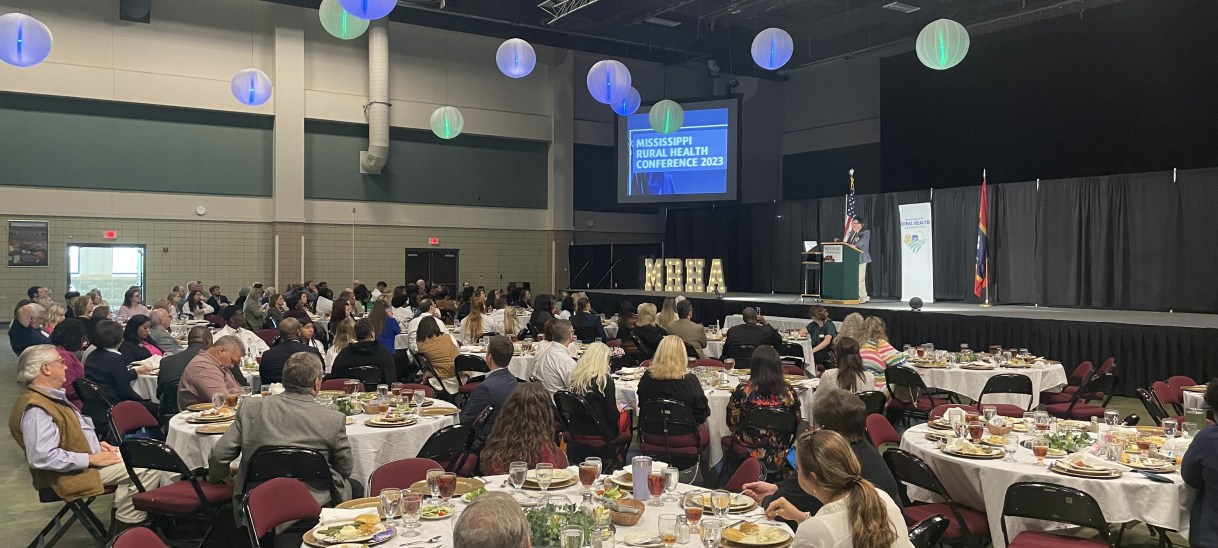
MRHA Recognizes Awardees at 2023 Annual Conference


Vicksburg, MS – November 23, 2023 – The Mississippi Rural Health Association (MRHA) honored key individuals and hospitals for their outstanding contributions to rural healthcare at its Annual Conference held November 16-17, 2023, at the Vicksburg Convention Center. The event, which took place on National Rural Health Day, brought together 215 healthcare professionals from across the state to celebrate excellence and commitment to the well-being of Mississippi’s rural communities.

The MRHA presents these prestigious awards to individuals, organizations, and healthcare providers that have demonstrated exceptional leadership, innovation, and dedication to improving the healthcare landscape in rural Mississippi. Below are the distinguished awardees for 2023:

State Legislator of the Year: Lt. Governor Delbert Hosemann

Lt. Governor Delbert Hosemann was honored as the State Legislator of the Year for his unwavering commitment to supporting rural healthcare in Mississippi. Throughout his tenure, Lt. Governor Hosemann has been instrumental in advocating for bills aimed at improving hospital infrastructure, increasing reimbursement rates, securing funding for rural clinics, and exploring strategic initiatives to strengthen rural healthcare systems. His leadership has been pivotal in advancing policies that enhance the quality of care for Mississippians in underserved areas.

“Lt. Governor Hosemann’s work in championing rural healthcare is a testament to his dedication to the health and well-being of all Mississippians,” said Ryan Kelly, MRHA Executive Director. “His tireless efforts have positively impacted rural communities, making healthcare more accessible and equitable.”

National Legislator of the Year: U.S. Senator Cindy Hyde-Smith

U.S. Senator Cindy Hyde-Smith received the MRHA’s National Legislator of the Year Award for her continuous advocacy at the federal level to support rural healthcare practices. Senator Hyde-Smith has been a strong proponent of national legislation that addresses the unique challenges of rural hospitals and healthcare facilities, including securing funding for rural hospitals, expanding telehealth access, and reducing the administrative burdens that disproportionately affect rural providers.

“Senator Hyde-Smith’s commitment to advancing rural health policy on a national scale has been invaluable to Mississippi’s healthcare system,” said Kelly. “Her leadership ensures that rural communities receive the attention and resources they need to thrive.”

Mary Ann Sones Distinguished Leadership Award: Patty Harper, MRHF

Patty Harper, a primary consultant with the Mississippi Rural Health Foundation (MRHF), was presented with the prestigious Mary Ann Sones Distinguished Leadership Award for her years of service in supporting rural healthcare providers. Harper has been a trusted resource, offering invaluable guidance on rural health clinic operations, management, and strategic planning. She has also been a key educator, leading numerous workshops and training sessions for MRHA members, equipping them with the tools they need to better serve rural populations.

“Patty’s work has touched the lives of countless healthcare professionals across the state,” said Kelly. “Her dedication to empowering rural health leaders is an inspiration to us all.”

One Rural Award: Dr. Dan Edney

The One Rural Award, which recognizes outstanding contributions to rural public health, was presented to Dr. Dan Edney, State Health Officer for the Mississippi State Department of Health (MSDH). Dr. Edney has worked tirelessly to enhance public health outreach in rural communities, including personally visiting rural hospitals to identify how MSDH can best support these critical healthcare facilities. His work is helping to bridge the gap in healthcare access for some of the state’s most vulnerable populations.

“Dr. Edney’s hands-on approach and unwavering support for rural healthcare make him a true champion of public health in Mississippi,” said Kelly. “His efforts are directly improving the lives of Mississippians in rural areas.”

Hospital Quality Awards

Each year, the Chartis Group recognizes the top quartile of hospitals in the nation based on quality outcomes from the Centers for Medicare & Medicaid Services (CMS). The following hospitals were recognized for their exceptional quality of care and commitment to patient outcomes:

  • Baptist Memorial Hospital – Attala
    Baptist Memorial Hospital – Attala has consistently demonstrated a commitment to providing high-quality care in the heart of rural Mississippi. The hospital’s patient-centered approach has earned it recognition for its excellent clinical outcomes and exceptional patient satisfaction scores. As part of the Baptist Memorial Health Care system, Baptist Attala plays a crucial role in serving residents of Attala County and surrounding communities with vital healthcare services, including emergency care, inpatient care, and outpatient services.
  • Baptist Memorial Hospital – Calhoun
    Baptist Memorial Hospital – Calhoun continues to provide high-quality, compassionate care to the residents of Calhoun County. The hospital’s commitment to excellence is reflected in its state-of-the-art medical services, which include emergency care, surgical services, and diagnostic imaging. Baptist Calhoun’s focus on maintaining high standards of care, while emphasizing patient safety and satisfaction, has helped the hospital stand out in the state’s rural healthcare landscape.
  • Baptist Memorial Hospital – Leake
    Baptist Memorial Hospital – Leake has earned recognition for its commitment to improving patient outcomes and providing comprehensive care for the community. From preventive services to specialized treatments, the hospital offers a wide range of services while maintaining a strong focus on quality improvement. The hospital’s dedication to continuous staff education and its investment in modern medical technology have made it a trusted healthcare provider for residents of Leake County and the surrounding areas.
  • Covington County Hospital
    Serving the people of Covington County, Covington County Hospital is known for its exceptional care in a rural setting. The hospital provides a range of essential health services, from emergency care to diagnostic services and rehabilitation, all with a focus on quality and patient-centered care. Covington County Hospital is also committed to creating strong partnerships with local healthcare providers, which enhances its ability to offer comprehensive care to its rural population.
  • Field Health System
    Field Health System, which includes the Field Memorial Community Hospital, is dedicated to improving access to healthcare in the rural communities of Wilkinson County and beyond. Field Health’s commitment to high standards of care has led to improved patient outcomes, especially in critical care, emergency services, and preventative health measures. The system has also been proactive in incorporating telehealth services to ensure greater access to healthcare for underserved populations.
  • Ochsner Watkins Hospital
    Ochsner Watkins Hospital is a critical access hospital in Mississippi that provides exceptional healthcare services in a rural setting. Known for its comprehensive care offerings, including emergency services, general surgery, and rehabilitation, Ochsner Watkins has built a reputation for excellence in patient care. The hospital’s commitment to adopting innovative healthcare solutions, such as telemedicine, has further expanded access to care for rural residents.
  • Ochsner Stennis Hospital
    As part of the Ochsner Health system, Ochsner Stennis Hospital plays a vital role in improving healthcare in the rural communities of Hancock County. The hospital has achieved national recognition for its high-quality clinical care and its emphasis on patient safety and satisfaction. With a broad range of services, from primary care to specialized treatments, Ochsner Stennis Hospital is a cornerstone of health in its region, particularly for elderly and low-income populations.
  • Ochsner Laird Hospital
    Ochsner Laird Hospital, located in Union, MS, serves as a lifeline for many in rural areas with limited access to healthcare services. The hospital offers a range of services, including emergency care, medical imaging, and rehabilitation. Through its partnership with Ochsner Health, Laird Hospital has continually worked to enhance its services with the latest medical technologies and clinical best practices.
  • North Mississippi Medical Center – Pontotoc
    North Mississippi Medical Center – Pontotoc is a key healthcare provider for residents of Pontotoc and the surrounding communities. The hospital’s emphasis on quality care, combined with its community-focused approach, has made it a trusted healthcare facility. From maternity services to emergency care, North Mississippi Medical Center – Pontotoc consistently demonstrates high levels of patient satisfaction and strong clinical outcomes.
  • Tallahatchie General Hospital
    Tallahatchie General Hospital, serving the rural community of Charleston, MS, is committed to providing high-quality healthcare close to home. The hospital has been recognized for its excellent emergency care, surgical services, and inpatient care, as well as its strong efforts in addressing chronic health conditions in the community. Tallahatchie General is a vital asset for its rural population, helping to reduce the need for patients to travel long distances for medical care.
  • North Mississippi Medical Center – Iuka
    North Mississippi Medical Center – Iuka is dedicated to offering comprehensive healthcare services to the residents of Iuka and surrounding areas. The hospital provides vital services, such as emergency care, outpatient services, and surgery, all with a focus on delivering high-quality, patient-centered care. NMMC – Iuka is an essential part of the region’s healthcare infrastructure, ensuring that rural communities have access to the care they need.
  • North Mississippi Medical Center – Eupora
    North Mississippi Medical Center – Eupora serves the rural areas of Webster County with excellent medical care. The hospital is known for its personalized, compassionate services, including emergency care, diagnostic imaging, and wellness programs. With a dedicated team of healthcare professionals, NMMC – Eupora is committed to improving the health of its rural community, ensuring that all patients receive the best possible care, regardless of location.

Mississippi Rural Health Fellows

The MRHA also recognized the 2023 cohort of Mississippi Rural Health Fellows for their impactful work in addressing pressing health challenges in rural communities. The cohort focused on two key areas: food deserts in Edwards, MS, and maternal health challenges in Lexington, MS. The fellows presented their findings and proposed actionable solutions to improve access to healthy food and enhance maternal health outcomes in these rural areas.

The 2023 Mississippi Rural Health Fellows include:

  • Mary A. Williams, DNP, FNP-BC, MRHF
  • Lacey Sones Shaw, MRHF
  • Lily Fran Guastella, MD, MRHF
  • Yolanda Pruitt, MS, CHES, MRHF
  • Jacqueline Carter, MRHF

Their innovative research and community-based solutions offer a roadmap for improving health outcomes in rural Mississippi.

Conclusion

The MRHA’s Annual Conference serves as a powerful reminder of the critical work being done by healthcare professionals and leaders throughout the state to improve rural health. The dedication and passion demonstrated by the awardees underscore the importance of continued collaboration and support for rural healthcare systems.

For additional information about the Mississippi Rural Health Association and the 2023 award winners, please contact Ryan Kelly at 601-898-3001 or email ryan.kelly@mississippirural.org.


About the Mississippi Rural Health Association (MRHA)
The Mississippi Rural Health Association (MRHA) is dedicated to improving the health and well-being of rural Mississippians by supporting and advocating for rural healthcare providers. MRHA serves as a resource for professionals in rural health, offering educational programs, policy advocacy, and initiatives aimed at addressing the unique challenges faced by rural communities.

Reeves Medicaid Plan is a Major Help to Rural Hospitals

Mississippi’s rural hospitals have been financially suffering for years.  As you have heard us say before, there is not one single reason for the red ledgers of our hospitals and not one single solution that will resolve the issue.  Rather, the “death by a thousand cuts” mantra has been widely used to describe the problem, and many different solutions have been offered to assist.  

In our most recent Governor’s Healthcare Task Force that set out to solve some of these issues, there were more than twenty different solutions offered to assist in reinforcing our rural health network.  Several of these solutions have already been made, including telehealth expansion, broadband expansion, a single source credentialing system for Medicaid, and more.  

One major solution that was also highly touted was a boost in Medicaid payments to hospitals by taxing hospitals and leveraging these funds for a federal drawdown of the Mississippi Hospital Access Program (MHAP).  By doing this, hospitals will pay $178 million in taxes but will provide $960 million in total funds to be distributed back to hospitals.  It is predicted that this plan would boost most hospitals’ bottom line by several percentage points, getting most into the black with around a 1% margin.

Granted, a 1% margin is not much, but it is enough to allow facilities to provide quality access to healthcare in both urban and rural areas of the state.  For our rural hospitals, this may be a critical lifeline needed to provide stability to the fragile system that we have.  The proposal has been submitted to CMS for approval, and once approved it will become law retroactive to July, 2023.  This will provide immediate relief to rural hospitals.

Now, this program does not expand Medicaid insurance coverage to any patients beyond current Medicaid guidelines, so further debate is sure to take place on this subject.  But, for now this seems to be a sorely needed relief for our rural hospitals and our rural safety net in general.

We are thankful to Governor Tate Reeves and Medicaid Executive Director Drew Snyder (and staff) for their hard work in designing this program and submitting it for approval.

This will be discussed in detail during several presentations at the Mississippi Rural Health Conference on November 15-17, 2023 in Vicksburg. 

Delta Region Community Health Systems Development Program Applications Opening

The next cohort for the Delta Region Community Health Systems Development (DRCHSD) Program is forming now. They are accepting applications from interested facilities now to begin programming in Winter 2023.

To learn more about the program and application process, you are invited to attend an informational webinars for hospitals and FQHCs on Tuesday, June 6th from 11am-12pm CST and for RHCs and small clinics on Thursday, June 29th from 11am-12pm CST.

The DRCHSD program is a collaboration between FORHP, DRA and the National Rural Health Resource Center and has served 54 health care organizations and communities since 2017. The program is open to Critical Access Hospitals, small rural hospitals, Rural Health Clinics, and other rural health care organizations and offers nearly $250,000 per year in technical assistance around quality improvement, financial and operational improvement, telehealth, community care coordination, workforce/leadership development, emergency medical services, and population health. In addition to TA, the program also provides financial support to facilities for the development and implementation of telehealth services, which includes funding for equipment, hardware, software, and training. 

Eligible counties in the State of Mississippi are included below.

DRA designated counties in Mississippi:

AdamsIssaquenaSharkey
AmiteJasperSimpson
AttalaJeffersonSmith
BentonJefferson DavisSunflower
BolivarLafayetteTallahatchie
CarrollLawrenceTate
ClaiborneLefloreTippah
CoahomaLincolnTunica
CopiahMadisonUnion
CovingtonMarionWalthall
DeSotoMarshallWarren
FranklinMontgomeryWashington
GrenadaPanolaWilkinson
HindsPikeYalobusha
HolmesQuitmanYazoo
HumphreysRankin 

FCC Proposed Rule on Rural Rate Setting for RHC Program

The Federal Communications Commission has recently released a proposed rule and a final rule and order concerning an interim and a proposed rural rate setting methodology for the Rural Health Care (RHC) Program. The final rule and order consists of various interim decisions made that concern how to determine rural rates, capitation on satellite services, and the invoicing process between the RHC’s Telecom and Healthcare Connect Fund Programs.

The current rate methods are as follows until a new method can be determined:

  • Method 1: The average of rates that the carrier charges for non-health care commercial

customers for the same or similar service in the rural area where the health care provider is located;

  • Method 2: If there are no other commercial providers in the rural area, the average of tariffed and other publicly available rates charged by other service providers for the same or similar services provided over the same distance in the rural health care provider’s area;
  • Method 3: If there are no such rates or the carrier reasonably determines that those rates would be unfair, a cost-based rate that is approved by FCC for interstate services.

FCC is proposing alternative sequential methods for determining rural rates:

  • Method A: The median of publicly available rates charged by other service providers for the same or similar services over the same distance in the rural area where the health care provider is located.
  • Method B: If there are no publicly available rates that would be used under Method A, the rural rate is the median of the rates that the carrier actually charges to non-health care provider commercial customers for the same or similar services provided in the rural area where the health care provider is located.
  • Cost-based rates: If the rural rate cannot be determined from Methods A or B, FCC proposes that service providers use a cost-based method with certain evidentiary requirements.
  • Capping the rural rate at the monthly rate in the contract or other agreement between the service provider and health care provider.
  • Requiring service providers with multiyear or evergreen contracts to justify rural rates only in the first year of the contract.

The notice of proposed rulemaking can be found on this website and final rules can be found on this website.

This proposed rule is open for comments until April 24th, 2023 on this website.

Mississippi Rural Emergency Hospital Conversion Process

The guidelines below have just been released by the Mississippi State Department of Health regarding the process of investigating and seeking approval for conversion to a Rural Emergency Hospital model.

Process:

  1. Notification:  Notify the MSDH Office of Licensure of the intent to convert to a REH on facility letterhead.   
  2. Required Documents (The following documents must  be included with CMS Federal Enrollment application [CMS PECOS] and State Licensure application):
    • EXHIBIT Model Attestation 
    • EXHIBIT Model REH Action Plan
    • Copy of executed Transfer Agreement(s) with Level I and/or Level II Trauma Center as required by 42 CFR § 485.538 Condition of Participation: Agreements (See QSO-23-07-REH for full details).
  1. Federal Application:  Prior to completing the licensure application, facilities should complete the CMS enrollment process to convert to a REH.  See the following enclosures for enrollment steps:
    • QSO-23-07-REH final.pdf
    • REH Medicare Provider Instructions
    • MLN2259384 CMS Rural Emergency Hospital Enrollment
    • Complete CMS Enrollment through the CMS PECOS Website at: https://pecos.cms.hhs.gov.  See REH Enrollment Instructions PECOS or 855A (attached).
  1. REH Initial Survey:  Eligible facilities that are existing CAHs and hospitals converting to an REH may attest to meeting the REH CoPs and will not require an automatic on-site initial survey as eligible facilities are expected to be in full compliance with the existing CAH and hospital requirements (as applicable) at the time of the request for conversion (See QSO-23-07-REH for full details).
  2. License Application:   After CMS has approved the conversion to a REH and the facility has received their new CMS REH provider number with effective date, click the following link to complete the MSDH Rural Emergency Hospital License application:   https://app.smartsheet.com/b/form/e688589dd5304695a4c78efaebfcd38e
  3. Fees:  There are no licensure fees to convert to a REH.
  4. License Effective Date:  Upon approval of the licensure application, the MSDH License Administrator will issue a REH License backdated to the effective CMS REH Certification date.
  5. Certificate of Need (CON):  CON approval is NOT required to convert to a REH, however, after receiving CMS Certification as an REH, your facility must contact the MSDH Office of Health Policy and Planning (CON) at (601) 576-7874 to request placing inpatient beds in abeyance (do not include acute beds allocated for a SNF Unit). 
  6. SNF Unit – Facilities considering adding SNF services in a Distinct Part Unit: 
    • Contact the CON office for a Determination 
    • Complete the CMS enrollment process – Contact the MSDH Long Term Care Division for additional information at 601-364-1110.
  1. License Renewal:  REH License year is January 1 – December 31.  
    • Renewal notices are sent in October. 
    • Annual renewal fee of $661.25.  

Contact the MSDH License Administrator at (601) 364-2722 with any questions.

Butler, Lane Elected to MRHA Board for 2023-2025 Term

The Mississippi Rural Health Association is pleased to announce the results of its recent board election. The association enjoyed a very competitive election of highly qualified and experienced candidates for the board. The top two candidates to receive votes were Toby Butler and Shana Lane.

Toby Butler is the Managing Partner of the Trilogy Healthcare Solutions LLC, a Partner in Trilogy Revenue Cycle Solutions LLC, and a Partner in Trilogy Care Connect LLC.  Toby is a proven healthcare executive with over 25 years of healthcare financial and operational leadership experience in the publicly traded, for profit environment, as well as the community based not for profit environment.  He has a passion for rural communities and has dedicated his career to helping rural hospitals and health systems identify and execute strategies to ensure the provision of quality, sustainable healthcare for the communities they serve.  Toby and his team at Trilogy are specifically dedicated to helping rural communities and their hospitals and health systems navigate the many changes and challenges facing rural hospitals and health systems.

Shana Lane, RN, CPHQ has been employed at Simpson General Hospital for 29 years. She is the Director of Quality, Infection Control, and Risk Management at the facility.  Shana currently serves on the HPIC Claims and Risk Management Committee, as well as the Compass Rural Health Advisory Panel. In addition, Shana has been elected to her third term on the Board of Alderman for the Town of New Hebron and has been appointed to the 2022-2023 MS Municipal League Health Committee.

Butler and Lane will fill the roles vacated by Michael Nester of H.C. Watkins Hospital, and Paula Turner of North Mississippi Medical Center. Both Nester and Turner completed their maximum terms on the board. Butler and Lane will join the remaining eleven directors on the board to begin the term in January, 2023.

For more information on the Board of Directors of the association, visit us at http://www.msrha.org.

TrueCare Announced as a New MississippiCAN and CHIP Administrator

TrueCare has awarded a notice of intent from the Mississippi Division of Medicaid to administer the statewide Mississippi Coordinated Access Network (MississippiCan) and the Mississippi Children’s Health Insurance Program (CHIP) with a proposed go live date of 07-01-2023. Please see the announcement from the state of MS Update on Mississippi Coordinated Care Procurement – Mississippi Division of Medicaid (ms.gov). 

Attached is the contract, roster template, HIE form and W9 that we would need to have reviewed, signed and filled out in their entirety. If you have any questions as you go through the process, please feel free to outreach to Dana Drew at Dana.Drew@caresource.com or her direct phone number is 717-701-6607. If faxing is a better option for you, please utilize 937-396-3825 for faxing.

Provider Agreement Signature Page

New Provider Contract

Roster Template

W-9

Mississippi Rural Health Association Recognizes Awardees at Annual Conference

The Mississippi Rural Health Association recognized significant individuals and hospitals for dedication to excellence during the Mississippi Rural Health Annual Conference held on November 17-18, 2022 in Jackson, MS. Held during Mississippi / National Rural Health Day, these awards are presented to symbolize and recognize the superior work performed by providers, administrators and facilities that makeup Mississippi rural health care system.

Awardees are as follows:

State Legislator of the Year: Sen. Ben Suber
Senator Suber, among many bills, sponsored the Rural Emergency Hospital bill that will allow hospitals to convert to a new model that emphases emergency care in rural communities.

National Legislator of the Year: US Senator Cindy Hyde-Smith
Senator Hyde-Smith has once again received this award from the association due to her continued support of national legislation supporting rural health practice, including hospital funding, telehealth, reducing administrative burden, and more.

Mary Ann Sones Distinguished Leadership Award: Paula Turner, MRHF
The Association’s top leadership award was presented to Paula Turner of North Mississippi Health Systems. Paula is a past president of the association and has been an active member for more than a decade. She has led substantial membership growth in the association and has been active in legislative support and advice to the association.

One Rural Award: Michael Nester
The One Rural Award is presented to Michael Nester, administrator of H.C. Watkins Hospital in Quitman, for his consistent work with the association as treasurer of the organization as well as having been very active in legislative advocacy, often traveling with the Association and MHA to Washington D.C. for legislative visits.

Hospital Quality Awards
Each year, the Chartis Group recognizes the top quartile of hospitals in the nation based on quality outcomes from CMS data. The following hospitals were recognized and awarded by the Association for this exceptional quality:

Baptist Memorial Hospital – Booneville
Baptist Memorial Hospital – Calhoun
Baptist Memorial Hospital – Leake
North Mississippi Medical Center – Eupora
North Mississippi Medical Center – Iuka
Baptist Memorial Hospital – Attala
Scott Regional Hospital
Neshoba County General Hospital
North Mississippi Medical Center – Pontotoc
HC Watkins Memorial Hospital
Laird Hospital
North Mississippi Medical Center – West Point

All award recipients received a recognition piece for their accomplishment. For questions or more information, please contact Ryan Kelly at 601-898-3001 or ryan.kelly@mississippirural.org.

5 Tips for Improving Efficiencies in the Health Information Management Department 

Rural hospitals are an integral part of our nation’s healthcare infrastructure providing critical services – from primary to long-term care – for nearly 57 million Americans. Recent years have presented countless challenges for rural hospitals. Factors such as rising cost of care, increased competition, lower reimbursement rates, unbalanced payer populations, reduced patient volume, uncompensated care, increasing labor costs and increased regulation have constricted operating margins for rural hospitals.

These challenges require hospitals to focus on efficiency to survive. While most savings initiatives focus on revenue cycle and care partnerships, our experience working with hospitals has uncovered innovative approaches to reducing the administrative load of Health Information Management (HIM) departments.

Click here to view five ideas rural hospitals should consider to reduce their Information Management expense.

2022 Legislative Summary

By Anthony Whisenant, policy intern –

The Mississippi Rural Health Association is pleased to report a successful legislative session this year. We have been supporting and tracking multiple bills throughout the year, working with lawmakers and supplying information to assist with successful passage. The following is a description of legislation that passed this year that the MRHA has been watching and supporting:

Mississippi House Bill 365 (top supported bill by the MRHA)

House bill 365 establishes the Mississippi Rural Hospital Loan Program in the state department of health to assist rural hospitals in providing needed direct healthcare services.  This increased funding will allow rural hospitals to offer additional services in their community that are not currently available there now, maintain or increase their staffing levels, and keep up with necessary facility maintenance.  For rural hospitals to be eligible for loans they must submit a financial audit proving they are in a good financial position.  The loan they receive may not be less than twenty-five thousand dollars or more than one-hundred thousand dollars.  The department will determine terms, conditions, and requirements for loans.  This loan program will be funded through a state appropriated $2.5 million in support. Note: the MRHA would love to have seen the loan amount increase to a cap of $1 million per facility, but this is a great start. A big thank you to Rep. Sam Mims for his sponsorship of this bill.

Mississippi House Bill 732

House bill 732 provides legislative intent to assure all Mississippians receive a consistent level of 9-8-8 and crisis behavioral service no matter where they live.  The purpose for the signing of this bill is to save lives of Mississippi residents by providing them better access to services pertaining to the behavioral health crisis.  This bill authorizes the state department of mental health to use technology that is interoperable across emergency response systems in Mississippi and to deploy crisis and outgoing services. 

Mississippi House Bill 1421

House bill 1421 establishes a grant program known as the Arpa Rural Water Infrastructure Grant Program in order to assist rural water associations in the construction of eligible drinking water infrastructure projects.  Upon approval, the department will enter into a project grant agreement with each guarantee to establish the terms of the grant for the project, including the amount of the grant.  In the first fiscal year after the effective date of this act, twenty percent of the funds appropriated to the department for the program will be obligated to projects that have completed plans and specifications, acquired all necessary land and/or easements, and are ready to proceed to construction. 

Mississippi House Bill 1538

House bill 1538 provides additional appropriation to the state department of health for the purpose of funding the Arpa Rural Water Associations Infrastructure Grant Program establishes under house bill 1421.  As a condition of receiving and expending the funds appropriated to the department under this act, the department shall certify to the Department of Finance and Administration that each expenditure of the funds appropriated to the department under this act complies with the guidelines, guidance, rules, regulations and/or other criteria.  It states that the money appropriated by the act will be paid by the State Treasurer out of any money in the Coronavirus State Fiscal Recovery Fund. 

Mississippi House Bill 1613

House bill 1613 makes appropriation to the Governor’s Office-Division of Medicaid for the purpose of providing medical assistance under the Mississippi Medicaid Law and defraying the expense of that law for the fiscal year 2023.  With this bill, the Governor’s Office – Division of Medicaid will provide statistical and financial reports monthly to the Legislative Budget Office and the PEER Committee.  These reports include an accounting of all funds spent in the medical program, the CHIP program, the Dialysis Transportation program, and each of the Home and Community Based Waiver programs.  The reports will also include an accounting of all funds spent in the administrative program, participant statistics, and any other information requested by the Legislative Budget Office and the PEER Committee. 

Mississippi Senate Bill 2738 (top supported bill by the MRHA)

The purpose of senate bill 2738 is to revise the definition of telemedicine as it is used in the statute requiring health insurance plans to provide coverage for telemedicine services.  It requires health insurance and employee benefit plans to reimburse providers for telemedicine services using the proper medical codes.  It provides that all health insurance and employee benefit plans in Mississippi must provide coverage for telemedicine services to the same extent that the services would be covered if they were provided through in-person consultation.  All health insurance and employee benefit plans in this state must reimburse providers who are out-of-network for telemedicine services under the same reimbursement policies applicable to other out-of-network providers of healthcare services.  A big thank you to Senators Boyd and Michel for their sponsorship of this bill.

Mississippi Senate Bill 2739

Senate bill 2739 requires nonemergency medical transportation (NEMT) providers to have a permit from the state department of health before they may provide NEMT transportation services in Mississippi.  It requires the department to adopt rules providing for applications of permits, issuance of permits, renewal of permits, and revocation of permits.  The bill authorizes the department to provide for the payment of fees for the issuance and renewal of permits.  It requires the department to adopt standards for the operation of vehicles used to provide NEMT transportation services.  The bill also authorizes the department to revoke the permit of or impose fines on any NEMT provider who is found to not follow the requirements and standards set by the department. 

Mississippi Senate Bill 2865           

Senate bill 2865 makes appropriation from the Coronavirus State Fiscal Recovery Fund to the Department of Mental Health for the purpose of assisting with behavioral and mental health needs.  The legislation intends that no funds under this act should be used to pay employee premium payments.  The bill states that as a condition of receiving the funds appropriated in this act, the Department of Mental Health shall obtain advice from the Office of the Coordinator of Mental Health Accessibility when determining the utilization of funds. 

Unfortunately one bill that did not pass this year was a bill sponsored by both the House and Senate to remove the Medicaid rate freeze, which was originally established in the Medicaid Technical Bill in 2021. This bill made it to conference, but unfortunately was not able to pass out of conference. We are hopeful that this rate freeze will be removed soon.

Note: The Mississippi Rural Health Association would like to thank its policy intern Anthony Whisenant for his work tracking this legislation and providing summaries to the MRHA membership.